|
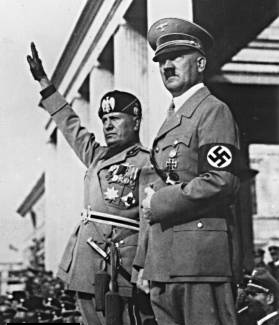
Hitler and Napoleon, the 2 Antichrists.
Adolf Hitler is interpreted as the second antichrist in
Nostradamus' quatraints. He is, without a doubt, one of the most evil men in the history of all mankind. He slaughtered millions of people, and he oppressed millions more. Although people can compare recent race crimes to Hitler's crimes, none can compare the scale of the crimes.
Before the second World War, Hitler participated in the first. He was a courier, and took his position very seriously. Anyone who knew him before the first World War and saw him during the war emphasized how happy and at home he was. He received the Iron Cross Second and First Class during this war. When the war ended, Hitler was hospitalized and openly cried when he heard of the armistice. He believed that a group of backstabbers had wounded Germany through the armistice. He vowed to avenge German nationalism and pride through political, if you can call it that, work.
He joined a small Nationalist group and turned it into a street-fighting, terror bringing, extreme left-wing,
political machine that witnessed many ups and downs. He reached office mostly through bullying and terror, but the citizens cared more for his patriotic words than for his troops actions.
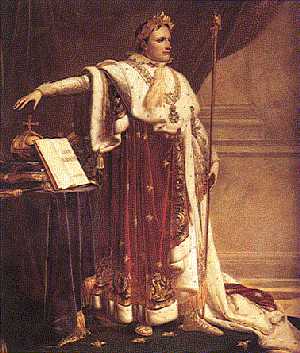
Napoleon Bonaparte is interpreted as the first antichrist in Nostradamus' quatraints. With the French army and citizens completely under his control, he used them to fight incessant wars. He did not kill as many people as Hitler, but he did send millions of men to their death without any remorse, in an age where one million people hardly ever lived in a single city, and European countries were composed of only a few million people.
Although he served in the French army, he was born in the French captured Corsica. Although his family was poor, they were of noble blood and profitted from their status with the French conquerors. Napoleon went to a prestigous military school because of his families connections with the French. He soon became an officer in the artillery branch, and performed brilliantly at the battle of Toulon. His fame rose, and after a one-sided defeat of the Austrians and Italians with
a much smaller force, Napoleon was raised to hero status. He then conquered most of Egypt, only to be forced to leave because of the complete destruction of the French fleet by the British. Nonetheless, he was still viewed as a military genious, and his rise to glory soon ensued.
|
|
Similaritys
1. When their countries had exhausted all of their manpower,they both conscripted children and teens into their service. Hitler conscripted the Hitler Youth, and Napoleon conscripted the Marie Louises (fifteen year olds)
2. Hitler and Napoleon were both immigrants in the country they ended up ruling. Hitler was was born in the small Austrian village of Braunau Am Inn just across the border from German Bavaria, and Napoleon was Corsican.
3. Both sensored intellectuals except in military technology. Hitler was always looking for newer, better weapons, but Napoleon was fine with the ones he had. They both exhiled leading philosophical and even some scientific scholars in an attempt to filter out the people who could not be dominated. Hitler also ordered many books to be burned in order to better establish his dominance over the masses.
4. Both conquered most of Europe. Although the map might have told a different story in Napoleon's case, most countries in Europe were mere puppet governments of Napoleonic France. Hitler's map made sure that Germany's boundaries clearly engulfed most of Europe.
5. Both thought that attacking Britain would be costly, and then both attacked Russia resulting in catastrophic defeat. Both viewed the Russians as barbaric and easily defeated in battle. Not to mention, both met their Russian turning points during the winter- Napoleon's at Borodino, and Hitler's at Stalingrad.
6. Both called for a fight to the death in their respective capitals when enemy armies were approaching them.
7. Both almost conquered Egypt, although Hitler's conquering of Africa had nothing to do with his orders. Erwin Rommel disobeyed orders and went on the offensive. Napoleon, on the other hand, was the French General who almost conquered all Egypt. He was forced to halt by the blockading English Navy.
8. Carl von Clausewitz, Hitler's military mentor, was in Napoleon's opposing Prussian army in 1806 and in Kutuzov's staff in 1812, again fighting against Napoleon.
9. Both served in the military before they became political candidates for their country's leadership. They also lived through distinct poverty after their initial glory days in the military.
10. Hitler, under his personal command and planning conquered all of Poland in only 24 days. Napoleon, under his personal command and planning conquered most of Austria and all of Sardinia in 9 days. They followed these victories with even larger, faster victories. Hitler with the conquest of the Netherlands, Holland, Belgium and France in just 25 days. Napoleon conquered Italy and more of Austria in less than one year with only 30,000 soldiers to start with against over 100,000. Hitler's odds were more even. After their campaigns, they practically raped the loser's territory, sending back bullion, art, and other valuables. Both captured many soldiers and a large amount of supplies and weapons as well. Also, Hitler and Napoleon's tactics were described as "lightening wars" by their oppositions.
11. Hitler and Napoleon were accepted as monarchs in a previously democratic society because of three major reasons: both countries were hoping for the returning strength of the monarchy, the populace was tired of inflation, civil war, and threats of invasion, and both militaries prefered aggressive patriots at their head as opposed to any professional politicians.
12. Their countries were in economic chaos, there was substantial opposition to their regimes, and there were difficulties with the church. Bonaparte wished to assert France's dominance over western and central Europe besides retaining her 'natural' frontiers; Hitler intended to create a Greater Germany and then to conquer eastern Europe. In addition, each was intent on building a new type of state with a new social order. Both enjoyed the advantage of more or less unlimited power, yet they assumed this power very carefully and legally.
13. Both pursued vigorous economic plans that balanced each countries' budgets, which had not been done in years: Bonaparte balanced the budget in 1802, the first time it had been balanced in over seventy years. Hitler managed to balance Germany's budget by 1938. Both Hitler and Bonaparte ended unemployment in their countries with nationwide projects. Neither Hitler nor Bonaparte came up with the ideas. The programs of Hitler were proposed by Georg-Hans Reinhardt and Hjalmar Schacht, and the programs of Bonaparte came from various able ministers. By elimating the economic crises in their countries and establishing a feeling of national security and pride, they raised national pride and patriotism to unprecedented levels.
14. Both men set up concentration camps at the beginning of their careers for political prisoners. Both Hitler and Napoleon had notorious henchman who murdered many men and women for their respective leaders. Napoleon had the Joseph Fouche, also known as the Butcher of Lyons, and Rene Savary, the leader of a crack force of mounted military police used only for the most dangerous assignments. Savary was used for heavy espionage work such as forging Russian banknotes in 1812, Austrian banknotes in 1809, and making a clockwork timebomb to dispose of the Bourbons in 1814. Fouche was used for anything dirty, including executions, and keeping a spy network. Hitler's SS acted in the same manner as the French Imperial Guard but were far more brutal and savage than the French. Hitler's ruthless henchmen included Heinrich Himmler who headed the security forces and spy networks, and Reinhard Heydrich- "the Hangman" or "the Blond Beast."
15. Both used the Church to attain most of what they needed: Bonaparte using the church much more and much more thoroughly than the Fuhrer. However, neither one believed in Christianity. Bonaparte was a deist and believed in a higher power, but Hitler was an athiest and he especially hated Christianity and its "Jewish" teachings. However, because the masses were Catholic, Hitler and Bonaparte were "Catholic" too, at least in appearances.
16. Both Hitler and Napoleon hoped to avoid war in the West. Hitler's many bluffs were intended only to get what he wanted, without war. Both Napoleon and Hitler gained favorable treaties before their large, costly wars began.
17. Napoleon and Hitler also agreed on an American policy. They both decided that America could not involve itself in a European because of economic reasons as well as the "isolationist" theories. This would come back to haunt Hitler, and these decisions would influence Napoleon to sell the newly acquired Louisiana to the Americans due to its "lack" of importance.
18. Hitler once said, "Since the Civil War, in which the Southern States were conquered against all historical logic and sound sense, the Americans have been in a condition of political and popular decay,' the Fuhrer exclaimed. "The beginnings of a great new social order based on the principle of slavery and inequality were destroyed by that war, and with them also the embryo of a future truly great America that would not have been ruled by a corrupt caste of tradesmen, but by a real Herren-class that would have swept away all the falsities of liberty and equality." He told Rauschning, "I am firmly convinced that in a certain section of the American middle class and the farmers, the sound fighting spirit of colonial days has not been extinguished." Hitler was no doubt encouraged by a "wholesome aversion for the negroes and the colored races in general, including the Jews. I guarantee, gentlemen, that at the right moment a new America will exist as our strongest supporter." He and Napoleon both believed American troops to be of poor quality, and although Napoleon may have been right, Hitler was right by no means.
19. Hitler was fond not only of new weapons, but also military theory. Among his eye-opening reading were Hanz Guderian's book Achtung Panzer and Giulio Douhet's theories on the effects of air raids on morale. The latter was definitely higher in the Fuhrer's self esteem because he would continue to deny necessary funds for tank production for years, and he would not allow leaders the freedom of command that the "armored idea" demanded.
|
 Conrasts
1. Napoleon once said, "We treat women too well and by doing so have spoilt everything. We have been very wrong indeed to raise them to our own level. The Orientals are much more intelligent and sensible in making women slaves." As he saw it, their sole function was to bear man children and satisfy his sexual needs. He continues, "What do most ladies have to complain of? Don't we acknowledge they have souls ... They demand equality! Pure madness! Woman is our property ... just as the fruit tree belongs to the gardener." Then in complete contrast, he describes their fighting power, "They are brave, incredibly enthusiastic and capable of the most frightful atrocities ... In a real war between men and women the only thing which would handicap women would be pregnancy, since the women of the people are just as strong as most young men."
Conrasts
1. Napoleon once said, "We treat women too well and by doing so have spoilt everything. We have been very wrong indeed to raise them to our own level. The Orientals are much more intelligent and sensible in making women slaves." As he saw it, their sole function was to bear man children and satisfy his sexual needs. He continues, "What do most ladies have to complain of? Don't we acknowledge they have souls ... They demand equality! Pure madness! Woman is our property ... just as the fruit tree belongs to the gardener." Then in complete contrast, he describes their fighting power, "They are brave, incredibly enthusiastic and capable of the most frightful atrocities ... In a real war between men and women the only thing which would handicap women would be pregnancy, since the women of the people are just as strong as most young men."
The Fuhrer was almost a complete opposite. Like Napoleon, he regarded them as an inferior species whose job was to bear children, be good mothers and make homes for men. However, he quotes, "Marriages that originate only in sensual infatuation are usually somewhat shaky ... Separations are particularly painful when there has been a genuine comradeship between man and wife ... a meeting between two being who complete one another, who are made for one another, borders already, in my conception, upon a miracle." He also refused women in his army because of the sympathies that male soldiers would bestow on the women, and the role that he felt they should play in society: Housewife. This is a complete contrast to Napoleon's dealings with women. Napoleon once told a frightened young actress, "Come in. Take your clothes off. Lie down." Napoleon had countless mistresses, but Hitler was with only one woman during his reign, Eva Braun.
On St. Helena, Napoleon scribed:
2. "I have implemented part of my scheme. Some excellent Jewish soldiers joined the French army, considerable wealth entering the country as a result. Had it not been for the events of the year 1814 many more would have come to France, since eventually every Jew would have wanted to settle in a land where equality before the law was guaranteed and where they could aspire to any honour."
At the other end of the spectrum, Hitler heaped disabilities and humiliations on German Jews from the moment he secured full control of the State in April 1933. They were purged from every profession, while in 1935, they were deprived of German citizenship and forbidden to marry or have sexual relations with 'racially pure' Germans; nor could they attend German schools or universities. During Reichskristallnacht, an attack by organized mobs on November 7, 1938, hundreds of synagogues went up in flames and seven thousand Jewish shops were gutted. By the end of 1938, over 30,000 Jews were "relocated" to concentration camps.
3. Napoleon enjoyed a large cavalry force. He cherished both his Imperial Guard and the cavalry above most everything else. On the other hand, because of the tank, Hitler and most of the rest of Europe saw the cavalry as both overly aristocratic and outdated. Hitler once told Speer, "Hunting and horse-racing, the last remnants of a dead feudal world."
Probably the most striking difference between Hitler and Napoleon was their plans or aspirations for the Jews and their role in society. Napoleon seriously believed that their religious and social disabilities should be removed, placing them on the same level as Protestants and Catholics; wherever his armies went he abolished ghettos. He hoped to persuade Jews from all over the world to settle in France and take a full part in the nation's life.
|