| Home Page
Napoleon
Wellington
2 Antichrists
Invasion of Russia
Guest Book Page
Waterloo
|
|
|
Napoleon
This is a Short Biography of Napoleon
|
| |
Youth
Born Napolione Buonaparte in Ajaccio, Corsica, the son of a lawyer. Both his parents were resistance fighters in a rebellion against the Genoese government of Corsica. The young Bonaparte went to school in France, attending the military academy at Brienne, then (in 1784) the Ecole Militaire in Paris. At the end of school, Napoleon received a commission as a second lieutenant in the artillery.
|
|
|
| |
Making of an Emperor
In 1789, France erupted in revolution, and in 1792 she went to war with Austria. Napoleon, who had returned to Corsica in 1792, was forced to flee with his family in 1793, as the Corsican civil war heated up. Rejoining his regiment at Nice, Napoleon was put in charge of the artillery at the siege of Toulon, where his achievements earned him a favourable report to the Convention at Paris.
That same year, he was promoted to brigadier-general, and the next year, 1794, saw him as army general in charge of the Army of Italy.
Briefly imprisoned during the Terror because of unfavourable political connections, Napoleon was soon released through personal influence. Over the next year, Napoleon rapidly moved up through the ranks of public office, ending up as commander of the Army of the Interior in 1795. When, later that year, a mob of Royalist sympathizers threatened the deputies of the National Convention, Napoleon dispersed the crowd through judicious use of "a whiff of grapeshot".
In 1796, the Directory appointed Napoleon to command the Army of Italy. Before leaving for the Italian campaign, he married Joséphine de Beauharnais, widow of a guillotined nobleman, at the same time changing the spelling of his name to the French form, to avoid drawing attention to his Italian origins.
The Italian campaign showed Napoleon's skills as a general to great advantage. An unbroken run of victories over the Austrian and Piedmontese armies, as well as Napoleon's personal bravery (storming a bridge alongside his own troops at Lodi) and concern for his troops, earned Napoleon the loyalty and even the love of his troops.
At Campo Formio in 1797, Napoleon concluded a treaty with Austria, on behalf of the Directory, cementing French control over Italy. The remaining nation at war with France, Britain, had near-total control of the seas, and Napoleon considered a direct attack impossible. Instead, he suggested attacking British interests elsewhere.
With approval from the Directory, Napoleon embarked on a campaign to capture Egypt, intending to use it as a stepping stone to an attack on British possessions in India. A French fleet brought Napoleon's Army of the Orient to Alexandria in 1798. Defeating the Egyptian armies, Napoleon lost his fleet to British Admiral Horatio Nelson at the Battle of the Nile in Abu Qir Bay. A prolonged stalemate ensued, with the French army held in Egypt by the British naval blockade.
As the situation in France grew more serious, with a coalition of European nations at war with France, Napoleon left his army in Egypt, returning almost alone to France in 1799. Back in France, he joined the plot to topple the Directory, culminating in the Coup of 18 Brumaire (9 November 1799). The coup left Napoleon as virtual military dictator of France, with the title First Consul.
Napoleon's response to the threat facing France was to reorganize his armies and restructure his defense. He successfully met and defeated Austria at Marengo and Hohenlinden in 1800. At the same time, he saw to his political stability, establishing a concordat with Pope Pius VII, by which the Roman Catholic Church was reestablished in France. In 1802, the Treaty of Amiens ended the Revolutionary Wars. Napoleon was now established as First Consul for life, and proceeded to reorganize French law, establishing the Napoleonic Code. As his efforts slowly created economic stability in France, his popularity with the people grew.
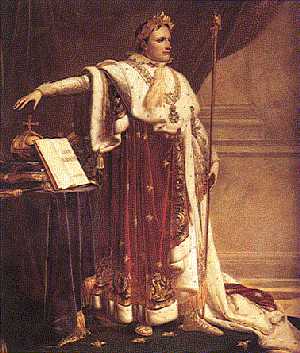
Soon, the fragile peace between France and her neighbours crumbled, and napoleoon began to plan for an invasion of Britain. A Royalist plot to kidnap him failed, and in 1804, he was proclaimed Emperor, and crowned in Notre Dame Cathedral in Paris.
|
|
|
| |
Building and Collapse of an Empire
Throughout the wars, Napoleon's enormous force of personality, and the great popularity he ejoyed with his troops, characterized his conduct. From 1803 to 1805, Napoleon's chief enemy was Britain. In 1805, however, Britain managed to organize a coalition of Austria, Russia, Sweden and Naples against France.
Napoleon's great skill as a general allowed him to perform the "military miracles" of 1805, defeating the Austrians at Ulm and a joint Austro-Russian army at Austerlitz. Despite these victories, his Grand Army, however dominant it might have been on the Continent, was unable to invade Britain. In this, Napoleon was thwarted by the British Royal Navy's dominance at sea. In 1805, at Trafalgar, Admiral Nelson finally ended any dreams of invasion, crushing Napoleon's fleet.
By the year 1807, Napoleon's imperial power reached from the Pyreneesin the South-West, to the Elbe River in the North, and to the coasts of Dalmatia in the South-East, a vast triangle of territory that encompassed most of Europe. He also held the titles of King of Italy, Mediator of the Swiss Confederation, and Protector of the Rhine Confederation. He appointed his brothers kings of the conquered territories: Jérôme of the newly created Westphalia, Joseph of Naples, and Louis of the Netherlands.
No longer capable of projecting force at sea, Napoleon attempted to undercut British trade interests on the Continent, imposing the so-called Peninsular Wars, from 1800 to 1814. At Wagram, he once again defeated the Austrians.
To Napoleon's disappointment, the empress Josephine had been unable to give him the heir he needed. As a consequence hereof, he divorced her, and married the Austrian emperor's daughter Marie-Louise, a provision of the Treaty of Schönbrunn (1809). In 1811, a son, François Charles Joseph Napoleon, was born.
In 1812, Napoleon finally made a strategic error. Suspicious of Russia's Tsar, Alexander I, Napoleon commenced a campaign to invade Russia. Initially defeating the Russians at Borodino, he found the advance into Russia hampered by the "burnt-earth" strategy practiced by the Russians, ably led by Mikhail Ilarionovich Kutusov. Advancing into a deserted and burning Moscow, his lines of supply critically overextended, his troops exhausted and Russia's harsh winter setting in, Napoleon must have realized that he had committed a major blunder. A costly retreat from Moscow ensued.
In the West, the Peninsular War proceeded equally poorly. Napoleon's generals, seledted for ability to follow orders rather than personal initiative, did poorly against the British. Under Arthur Wellesley, later the Duke of Wellington, the British forced the French out of Spain.
Napoleon, returning from Moscow, found a France threatened on all sides, rife with rumours of his death. Near Leipzig, in 1813, he suffered a major defeat by an allied force at the Battle of the Nations. The following year, 1814, the Allies took Paris.
Napoleon abdicated in favour of his son and attempted suicide by poison. The French Senate, rejected his conditional abdication, forcing the reinstatement of the Bourbon dynasty, in the person of Louis XVIII.
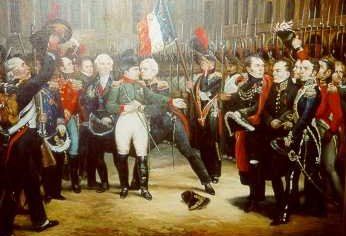
Napoleon was exiled Elba, an island off the Italian coast, which was given him as his own "kingdom". When the government of Louis XVIII failed to pay him the agreed-upon pension (as promised under the Treaty of Paris of 1814), and when access to his wife and son were denied him, however, he became angered.
The unpopularity of the new monarchy encouraged him to escape from Elba, landing in France with 1500 men. On his march to Paris, he collected devotees along the way, making a triumphant entry in March 1815, and forcing Louis XVIII to flee to the Netherlands. Over the next 100 days, he raised a new Grand Army, with the aim of striking at the allied armies, currently dispersed. At Ligny on 16 June 1815, he defeated Blücher, but two days later, on 18 June 1815, at Waterloo in Belgium, he was decisively defeated by Wellington.
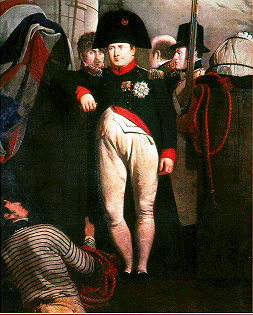
Shortly after this defeat, Napoleon abdicated in favour of his son, surrendering to the British. He was exiled to the Atlantic island of St. Helena. He never saw his family again, dying a few years later of a stomach ailment. In 1840, his body was returned to France, and interred in the Hôtel des Invalides in Paris.
|
|
|
|
|